

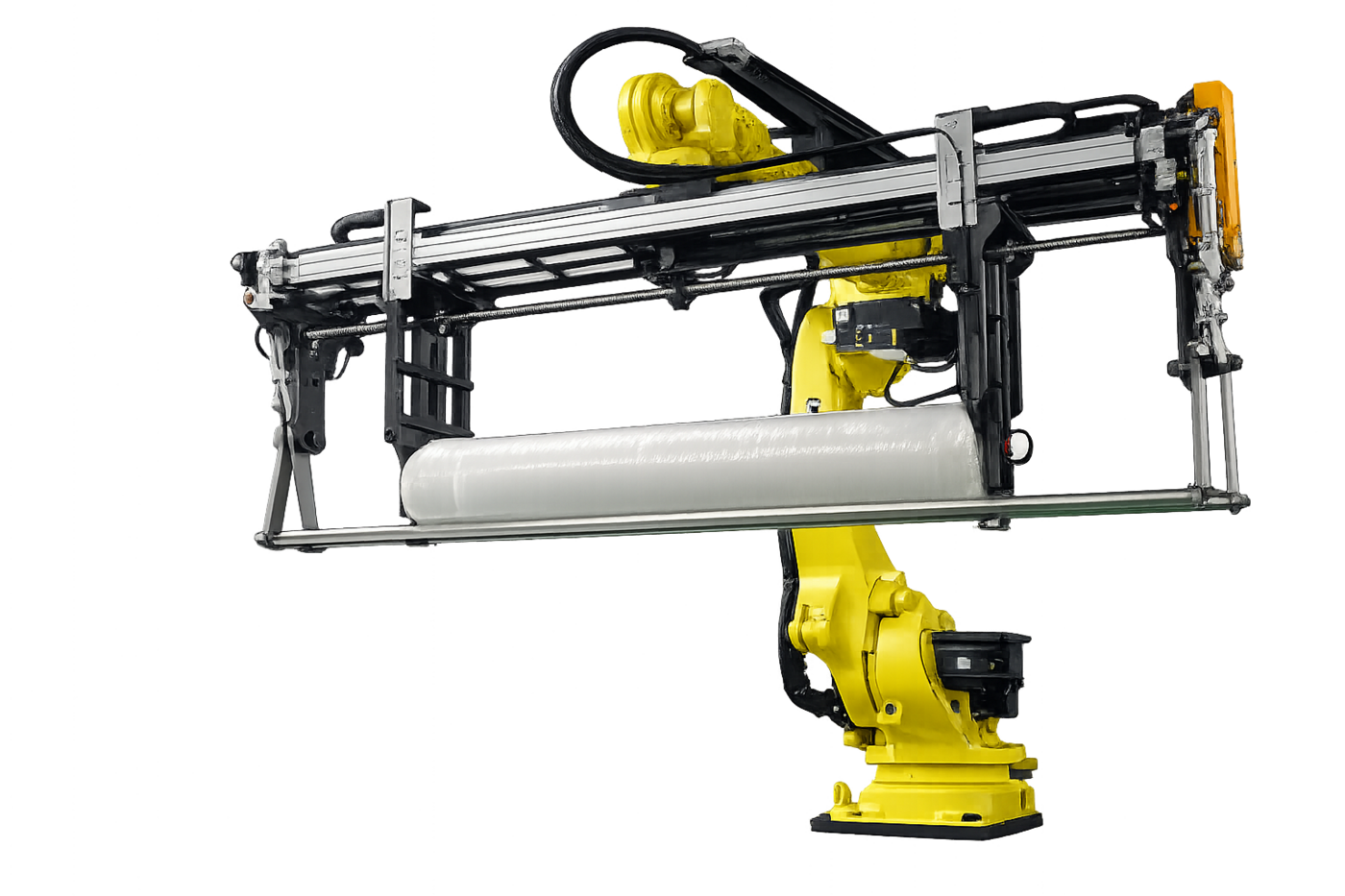
Automated transfer and palletizing: Robots lift heavy fabric rolls, winding rolls and nonwoven rolls and stack them accurately on pallets.
PRODUCT
Industrial Robot SI
Robots accurately perform work that is difficult for people — we design and build automation systems tailored to each site.
Factories involve many heavy, repetitive and hazardous tasks. STIGMA introduces industrial robots into these processes to reduce the burden on workers while improving both productivity and quality. We go beyond simply installing robots. From the hand that grasps the product (gripper) to the control software, we design each system for the shape of the product and the site environment. Our modular configuration enables immediate application without major changes to the existing production line.
Processes We Automate
Packaging automation: Plastic wrapping, barcode recognition, sorting and palletizing are connected in a single workflow.
Cleaning and drying automation: Objects prone to contamination, such as dye containers, are automatically cleaned and dried.
Monitoring and history management: Digital twins and a warehouse management system (WMS) provide real-time operating status and accumulate process data.
STIGMA's Strengths
Customized Consulting and Design that Preserve Existing Equipment
There is no need to replace the entire production line to introduce robots. STIGMA makes maximum use of existing equipment and provides everything from preliminary site diagnosis and consulting to system design and digital-twin simulation so that robots can perform their intended roles. Robot operations are verified in a virtual environment before installation, reducing trial and error and investment costs.
Protective Design Meeting Safety Standards
Industrial robots are subject to safety inspection under the Occupational Safety and Health Act. STIGMA integrates protective devices such as safety fences and area safety sensors with the robot from the outset, building systems that satisfy risk assessments and the Korea Association of Robot Industry's industrial-robot safety inspection standards.
Dedicated Grippers Designed for the Product
Even difficult-to-grasp objects such as cylindrical rolls and heavy containers are held securely.
(Related patents held)
Data-Connected Operations
Digital twins enable virtual commissioning, equipment failure prediction and connection to existing MES and ERP systems.
What Changes After Deployment?
- 01

Achieves higher productivity, lower costs and fewer defects at the same time
- 02

Prevents musculoskeletal disorders and industrial accidents
- 03

Helps address labor shortages in strenuous, unpopular processes
Deployment Cases
Palletizing Robot System for Fabric Roll Packaging & Transfer — BYUKJIN BIOTECH
Daily output +20%Cost -50%
Robots automate the process of wrapping finished fabric rolls in plastic, sorting them by type and palletizing them. — Installation completed in December 2025


Palletizing Robot System for Nonwoven-Roll Winding, Transfer — SEYANG NEW MATERIAL
Daily output +42.9%Defect rate -50%Cost -26.1%
Winding, transferring and palletizing heavy nonwoven rolls are integrated and automated with one multi-gripper and a digital twin. — Installation completed in March 2026

